Finding Joy Through Serving Others

by Apr 12, 2021

By Brianne Loritz

My name is Brianne Loritz and I have been regularly attending epikos church for around three years now. I add the word regularly because prior to this, church was something I did when it was convenient and comfortable for me. It was not until I was encouraged by my wonderful small group that I learned the importance of putting aside my own interests and having Christ at the forefront of my life. Once I began to live a life focused on Christ, it was not long before my heart was changed and I became more and more involved with the church. I loved serving on the Connections Team and attending small group on Tuesday nights, but something was still missing. As I became more comfortable in my Christian community, Christ quickly called me to step out of my comfort zone and search for ways to serve the poor in my city.

Initially, my thoughts went to what organization would be the best fit for me, when would serving fit in my busy schedule, and how would this benefit my relationship with the Lord. While these were areas to consider, I was still missing the bigger picture. Conveniently, at this time I was attending an Equip-U Class offered at epikos called “Loving Your Neighbor As Yourself” led by Andy Buck. During this class, we focused on common mistakes people make when looking to serve or help the poor. While donating money and resources is helpful, he encouraged us not to feel as though we need to “fix” people or their situation. Instead, we were encouraged to truly get to know those hurting around us and make loving, meaningful relationships with them. Since in the bigger picture we are loved unconditionally by Christ, we, therefore, ought to unconditionally love others. This was exactly what Milwaukee Rescue Mission (MRM) offered: an opportunity to recognize my own dependence on the grace of Christ and in return, love those in need within the community.

At MRM, I began serving in the Joy House which is a shelter for mothers and their children (and also a single women’s shelter is coming this summer!) I was welcomed by the friendly staff and other volunteers. Everyone started as strangers, then soon became close friends as we served closely together more each month.

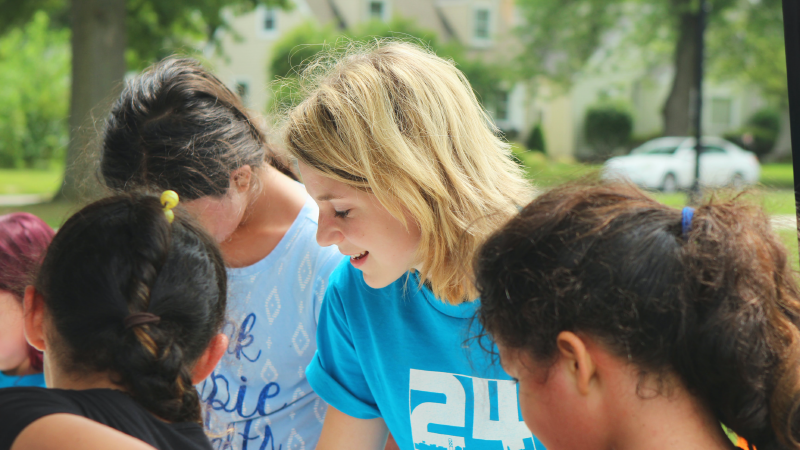
A typical night of serving consists of a some light cleaning (toys, tables, etc), preparing snacks for the kids, and interaction with the mothers and children ranging in age from infants to 17 year olds. Each night of the week varies in activities but typically the mothers attend class/bible study while the children participate in gym time, arts/crafts, or a bible study organized by staff or volunteers. During this time, we volunteers are able to hang out with the children and hear their stories. At MRM, we are free to discuss Jesus and share His message with the mothers and children, some who have never heard His word before.

As I became more involved, my capacity to serve grew by relying on the strength of Christ’s love over my own abilities to serve others. The fears I had in the beginning, such as how can I relate to these women and children or what do I say to comfort them, soon were gone as God revealed to me that just spending time and showing compassion goes a very long way. Something as small as a listening ear, a hug, or a prayer was exactly what they needed to lighten the burden of their struggles even if it was only for a moment. These humbling experiences have left my heart so full of joy I catch myself walking away on Wednesday nights with a smile on my face praising God for bringing these people into my life.

I am thankful to be a part of a church that values serving the larger community. My hope is that we, the community of epikos, can continue to serve alongside one another and be the hands and feet of Christ in this city. I pray God will soften the hearts of more individuals to take part in our calling of service to those who are in need. “…whatever you did for one of the least of these brothers and sisters of mine, you did for me.” Matthew 25:40

How Hebrew Poetry Works

Rhyming Thoughts

While Western poetry often relies on metered rhyme (similar-sounding words), ancient Israelite poetry doesn’t follow a master system of meter or sound. Instead, its primary organizing principle is the parallelism of lines—essentially, biblical poets “rhyme” thoughts and ideas rather than sounds.

  1. The Heartbeat: Parallelism Parallelism is an “associative mode of thought” where two things are placed next to each other to show their relation. It assumes that to truly understand an idea, you need to grasp another idea that is both similar and distinct. There are three main types:
  • Synonymous: The second line repeats the first using different words (e.g., “The heavens declare the glory of God; / the skies proclaim the work of his hands”).
  • Antithetical: The second line contrasts the first, often using the word “but” (e.g., “The Lord watches over the way of the righteous, / but the way of the wicked leads to destruction”).
  • Synthetic (Progressive): The lines build on each other to tell a developing story or narrative.
  1. The Color: Imagery & Metaphor Biblical poems are “terseness” personified—they use fewer words than normal speech to communicate rich, imaginative experiences. To understand them, we must understand the ancient Israelite worldview. Common metaphors include:
  • The Shepherd: Signifying God’s care, provision, and leadership.
  • The Rock/Fortress: Representing stability, safety, and refuge.
  • Unsafe Landscapes: Using deserts, storms, or waves to signify fear or tests of faith.

The Architecture: Structural Glue

The psalmists didn’t just write individual lines; they used sophisticated “structural glue” to organize their prayers into larger units.

  • Stanzas: Groups of lines that form a distinct “paragraph” or unit of thought.
  • Refrains: A phrase repeated at intervals, like a musical chorus, grounding the reader in a recurring truth during shifts in mood.
  • Inclusio (The Envelope): This is when a poem begins and ends with the same phrase. These “bookends” signal that everything in the middle should be interpreted through that specific frame.
  • Chiasm (Symmetry): A pattern where themes are repeated in reverse order (A-B-C-B-A). In a Chiasm, the “C” (the center) is the “hinge”—it is the most important point the author wants to make.

Our Language of Faith

Themes to Look For

As we dive into the Psalms together, use your reading guide to look for these six specific themes. These aren’t just categories; they are the “language of faith” that helps us trust in Jesus, become like Jesus, and do as Jesus did.

  1. Praise & Hymns (The Language of Adoration) These are songs of “orientation”—they recognize the right order of the world with God at the center. This language is used to express direct worship for who God is, not just what He has done. When we pray these, we align our hearts with the truth of His character.


  2. Lament (The Language of Raw Honesty) About one-third of the Psalms are laments—cries of pain, protest, and confusion. This is the language of “disorientation.” These psalms give us permission to bring our grief and anger to God. They remind us that God welcomes our honesty, and bringing our pain to Him is actually a profound act of faith because it assumes He is listening and He is the only one who can help.


  3. Petition (The Language of Asking) Petition often goes hand-in-hand with lament. It is the specific cry for help, protection, or intervention. Whether asking God to “wake up” or to “be a shield,” this theme gives us the words to express our total dependence on Him when we are in distress or facing injustice.


  4. Thanksgiving (The Language of Rescue) This is the language of “new orientation.” These psalms are the “before and after” stories of the Bible. They are prayed after God has delivered or rescued the psalmist. They move beyond general praise to specific gratitude for a concrete act of God’s faithfulness in time and space.


  5. Wisdom (The Language of Reflection) Wisdom psalms (like Psalm 1 or 119) invite us to reflect on how to live life well. They often contrast “two ways” of living—the way of the righteous who meditate (hagah) on God’s Word and the way of those who ignore it. This language helps us navigate the complexities of life in light of God’s instructions.


  6. Royal (The Language of Hope) Royal psalms focus on the King or the promised “Anointed One.” While they originally spoke of the Davidic kings, they point us toward the ultimate King, Jesus. This is the language of waiting and hope, looking forward to the day when God’s Kingdom fully arrives on earth as it is in heaven.

Reflect & Apply:

The 150-Day Challenge

Our challenge to you is to read one Psalm a day over the next 150 days. 

Choose Your Journey
  • The 150-Day Challenge: Read one Psalm a day for a steady, transformative experience.
  • The Five Books & Torah Plan: Early Judaism arranged the Psalms into five “books” to mirror the five books of the Torah. This plan invites you to read the Psalms alongside Genesis–Deuteronomy to see how our prayers and God’s instructions connect.

As you read, use these three questions from your bookmark to guide your meditation:

  • How should this psalm make you feel? Notice the psalmist’s raw honesty. What emotion is it designed to help you express to God right now?
  • Where is Jesus? Many psalms come from someone waiting on God. What is this psalm waiting for? Does Jesus answer that wait, or did He experience that same wait Himself?
  • Can you use this psalm to talk to God right now? If so, pray it! If not, “hide it in your heart”—you may need it soon.
Happy meditating (hagah-ing)!


Dive Deeper

Recommended Resources

If you want to go even further in your study of biblical poetry and the Psalms, here are some excellent resources compiled from our class:

Watch & Learn

The BibleProject has created several incredible video series that bring these concepts to life. We highly recommend checking out:

How to Read the Bible series: Includes specific videos on Poetry, Poetic Metaphor, and The Book of Psalms.

Read & Explore